
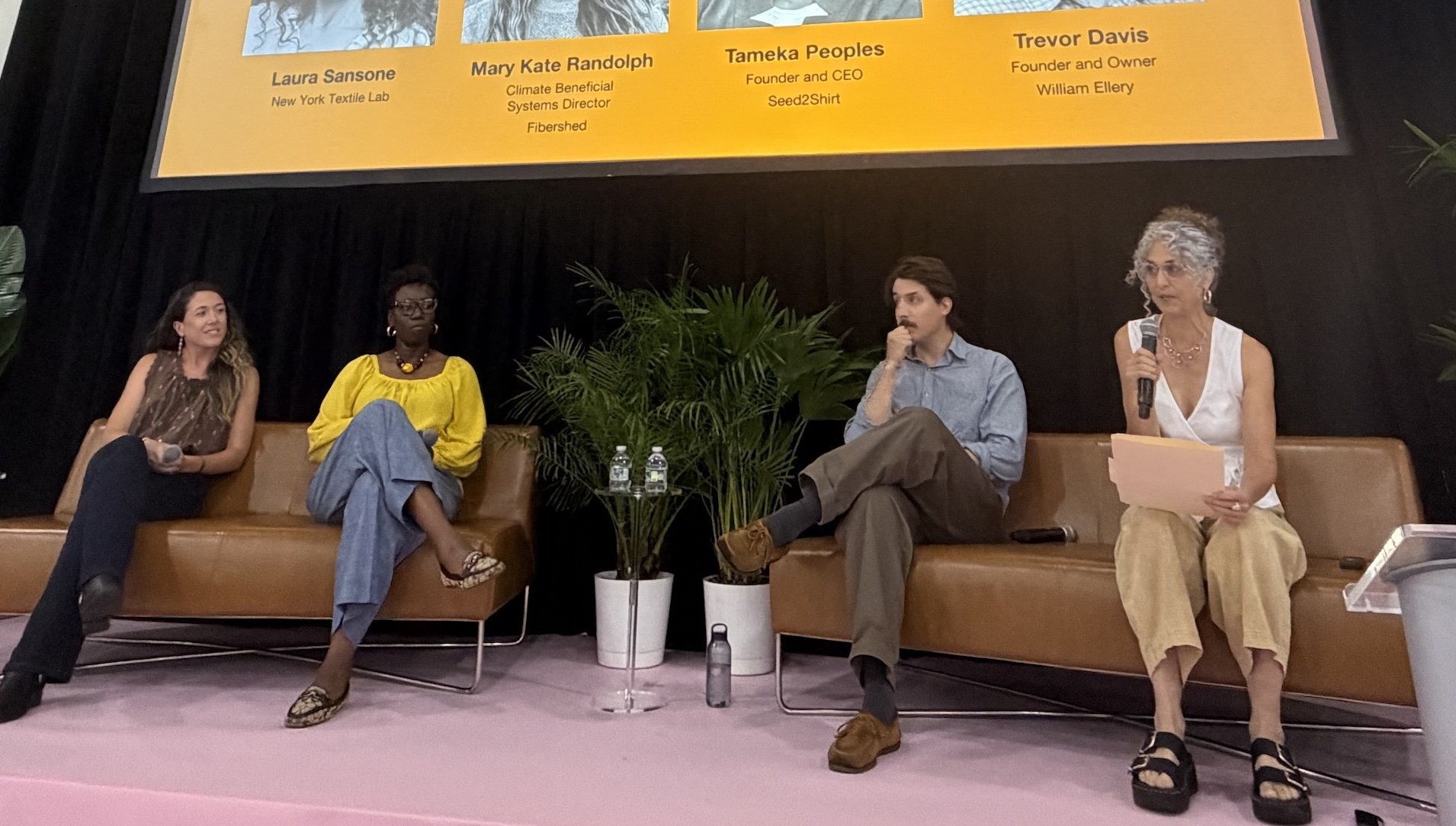
As the fashion industry confronts mounting climate challenges and supply chain instability, rebuilding regional textile ecosystems serves a triple purpose—lowering environmental impact, boosting social equity and creating business opportunities. A recent panel at Texworld NYC—From Soil to Studio: Rebuilding Regional Supply Chains in Fashion—brought together leaders working across the fiber value chain to explore how regenerative agriculture, domestic manufacturing and cross-sector collaboration can reshape the future of American textiles.
Mary Kate Randolph, Climate Beneficial Systems Director at Fibershed; Tameka Peoples, founder and CEO of Seed2Shirt; and Trevor Davis, founder of William Ellery, agreed that rebuilding regional supply chains goes beyond just relocating production closer to home—it requires rebuilding trust, investing in communities and creating stronger connections between growers, manufacturers, brands and consumers.
Regeneration Needs a Business Case
Fibershed’s Climate Beneficial™ program, originally rooted in California, now works with farmers and ranchers to adopt regenerative practices in broader rural communities. But, Randolph stressed, “the most important thing is connecting that to markets via our implementation partners—Tameka and the Southeast for cotton, the Northern Great Plains for wool, and California for a mix of cotton and wool.”
Regenerative agriculture has large benefits for soil and farm longevity, but it will only be supported and succeed when environmental outcomes translate into economic opportunity. Farmers and ranchers need to know that they’ll be rewarded for regenerative agriculture, which not only takes more effort but is also more costly.
“We use a blended financing model that looks like incentive payments through state or federal funding opportunities, and also making sure that we’re integrating all of these new practices with growers,” she said.
While a “balancing act” to build trust and credibility, both with brands and industry, Randolph continues to see opportunities. She measures success in what she calls the Beneficial Five—or B5 outcome metrics— across soil health, water, biodiversity, carbon capture and communities. This ensures that measurable outcomes are tied to the stories of growers and the landscapes they steward.
“If you’re a brand investing dollars into this, what are you able to report on and claim back to your own reporting needs and ultimately storytelling?” she said. “Data is great, but we all need to keep it human.”
Building Equity Into the Supply Chain
Another very human issue is representation, and Peoples emphasized that rebuilding supply chains must also address long-standing inequities. Through “social enterprise” Seed2Shirt, she works to ensure traditionally underrepresented Black cotton farmers have a prominent place in regenerative sourcing.
“For Black farmers, 200 years of disinvestment takes a lot of support to counter what has already been done. So you’re not working in 10,000 acres of cotton farms, you’re working in 500 acres,” Peoples said, noting that a major mission is also de-risking operations for farmers and helping them get certified.
As a global cotton merchant, Seed2Shirt pools the cotton from its various growers and helps navigate how to bring it to market as a tier 3 and 4 supplier. She cites an R&D element as important to not just meet required minimums, but to see what blends are possible. “Are there mills that can work with cotton and wool now? We have to be innovative to bring product to market.”
The organization also works to help brands align their material strategies with growers’ production cycles. “How can we create a calendar and a tool so that you can look at when you need to order these fibers from us, such that we can work backwards with our growers?” she said. Success depends on coordinating farmers, mills, logistics providers and brand teams years in advance or “you won’t see the fiber uptakes at the rate they need.”
The top three departments that contribute to sourcing within brands are innovation, materials and sustainability teams, and if those things aren’t aligned, it becomes much more difficult for sustainable programs to take off and to become evergreen inside of a company, she said.
Relationships Are the New Infrastructure
At William Ellery, rebuilding American manufacturing also begins with relationships. The outdoor and workwear brand has committed to producing in the United States “unless there’s a reason not to,” rejecting offshore manufacturing simply to lower costs. Instead, the brand builds lasting connections with domestic suppliers and customers alike.
Davis encourages brands to support “the people around you, so that these aren’t really business relationships, but rather your own community.” That philosophy extends to storytelling, where customers become “a lifelong part of the community rather than just a customer,” and can be moved to buy a wool coat in the middle of July because the brand’s story “changed their perspective.”
American manufacturing has its challenges, especially for small companies that not only must deal with minimum order quantities, but compete with larger manufacturers awarded contracts by the military industrial complex. “We have to get creative on how to weasel ourselves in,” he said. William Ellery leaned into hosiery, which has a strong manufacturing base in the U.S. The brand took a strong position in wool socks using leftover mill ends and making creative, small-batch designs.
Looking ahead, the panelists envisioned a more regional and collaborative textile economy. Davis called for greater “geographical diversity,” where products reflect the fibers and landscapes of their regions. Randolph imagined consumers discovering textiles that express the unique qualities of local fiber systems, while Peoples advocated for treating small farmers as “research and development partners” and creating cooperative investment models that share both risk and opportunity.
Ultimately, rebuilding domestic manufacturing will require cooperation across brands, governments, mills and growers. “Working together is the only way to really move forward,” concluded moderator Laura Sanson of New York Textile Lab.


