
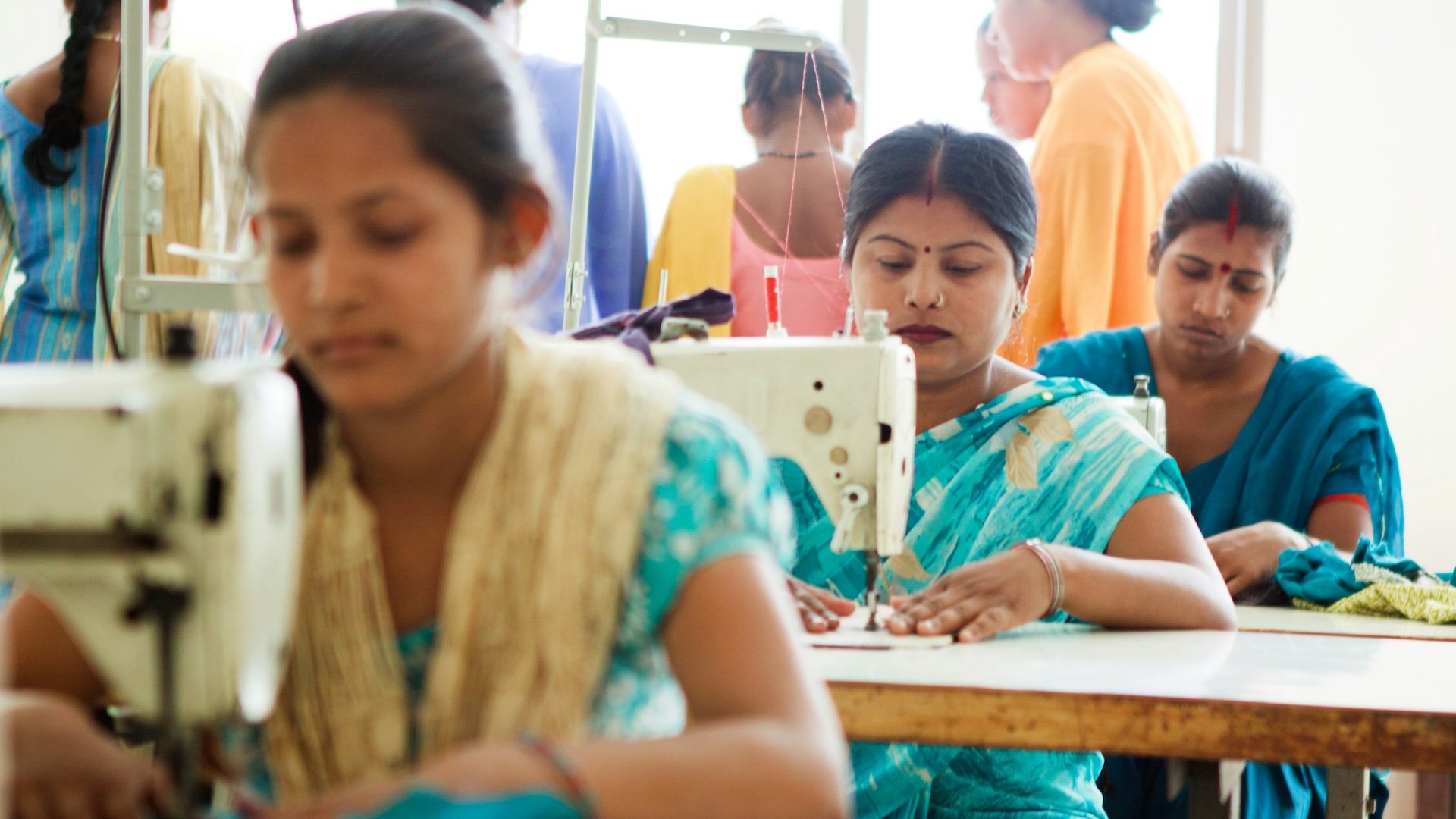
2026 has started off on a very different foot for India than last year. At the time, the country seemed poised to finally fully capitalize on its strengths in apparel production to take market share. That was before Trump’s so-called “Liberation Day” and the subsequent doubling of the tariff on Indian goods entering the U.S. With a 50% duty, the tenor of producers in the country changed from thriving to surviving. Initially, the collective hopes were pinned to November, when rumor had it the two nations would come to a new agreement that would offer some relief. Weeks later, the ready-made goods sector continues to hang on but with each passing day, the question remains: for how much longer?
Depending on who you ask, the answer varies, but not by much. The industry seems to agree that India is facing a critical moment for suppliers. Until then, executives at production facilities across the country are left to continue to find ways to salvage their U.S. business. While their efforts are largely working—they come at a steep price.
“As of now, we are servicing the spring orders, even at the cost of suffering losses, because we do not want to lose the customer base, because we are cognitive of the fact that once a customer goes away, it’s difficult to get them back,” said Mithileshwar Thakur, secretary general at the Apparel Export Promotion Council (AEPC) association.
Rohit Joshi, chief operating officer and vertical head at sourcing company Impulse International, said buyers in the U.S. have reacted in one of two ways.
“Retailers with a large sourcing base in India, they continue to buy and have asked suppliers to partner with them on the increased tariffs. Suppliers have pitched in with a 5-15% discount, covered partly by the improved receivables due to currency rate change,” Joshi said. “Retailers with small sourcing have moved to other countries, and sourcing for them remains country agnostic.”
Ashesh Amin, CEO & founder of New York-based sourcing company Pivot Apparel, which owns and partners with factories in a variety of regions with a focus on China, India and Egypt, also characterizes buyers as split in two segments: those that are willing to partner even through the current situation and those that are “me first, you last.”
Whatever the sentiment across the table, factory executives have had to take a (hopefully) short-term hit in order to protect future orders. But it’s a position no one wants to be in—and one that cannot persist, Amin. said.
“In our case, our vendors are actually absorbing a lot of our tariffs. They are absorbing it, and a little bit we are absorbing, and a very little bit the customers are absorbing. So, I think what we need to recognize is that they are all short-term resiliencies,” Amin predicted. “After some time, then something gives.”
That “something” could very well be the factories themselves, according to Thakur.
“By and large, everybody is operating at a loss,” Thakur stated. “Of course, bigger ones are the ones with deeper pockets, so they are able to absorb it better. The smaller ones are in deep distress.”
Thakur predicts job losses and factory closures if the current situation continues.
The clock is ticking
Already, Joshi reported that some larger factories are shuttering some units and consolidating. While he said that allows them to hold ground, he gives it another two quarters before they face what he calls “major impact.”
Manish Bharati, chief business officer at Raymond Lifestyle, parent company of tailored menswear producer Silver Spark, places the critical time frame even earlier. Ideally, he said, any rebound would happen in time to have a positive effect on 2026. “Hypothetically, if an announcement is done in March or early April, the bulk of holiday would have gone. By the time buyers react, it would be for the spring season,” he said.
“By and large, everybody is operating at a loss. Of course, bigger [factories] are the ones with deeper pockets, so they are able to absorb it better. The smaller ones are in deep distress.”
—Mithileshwar Thakur, Apparel Export Promotion Council (AEPC)
Thus far, Silver Spark, has been able to avoid dire outcomes, in part because it is a relatively modest part of a much larger entity. As approximately 20% of the Raymond conglomerate, the subsidiary has been able to offer the discounts necessary to keep most of its customers from fleeing to competitors. But even with its parent company’s might, Bharati said there’s a limit. He estimated the company offered discounts on 75 to 80% of its orders in the second half of 2025, a practice it would have to maintain as long as the current tariff rate remains in place.
“It is very, very obvious for everybody that this will not sustain in the longer run. And people will have to more aggressively diversify into the other markets,” he said. The concern, according to Bharati, is that buyers too will look elsewhere. Already, his U.S. business is down.
Previously, the U.S. represented 67% of Silver Spark’s exports. This fiscal year, Bharati expects that number to drop to 59%. And he thinks his company’s experience is typical. In ballpark numbers, he guesses Indian producers have lost 5 to 10% of their U.S. business—with some seeing slightly steeper declines.
“Everything is attributable to the tariff situation,” he said.
Sameer Bhand, vice president of strategy & sustainability for Pratibha Syntex, a vertical manufacturer, reported a similar experience. The company, which had seen exports to the U.S. reach 30% before the trade war, now says the country makes up just 20 to 22% of its international business.
And that number could erode further.
While Pratibha Syntex, like others, is offering discounts to retain buyers, it may not be enough. Bhand said it’s no longer about concerns over producers’ prices, brands and retailers are now reacting to the continued uncertainty. The constant drumbeat of tariff threats coming out of Washington could prompt even the most devoted buyer to break ties with the country, he said. The Trump Administration’s recent announcement that it might place a 25% tariff on nations trading with Iran and a 500% tariff on countries that buy Russian oil are just the latest reasons for retailers to be wary.
“It’s a very, very volatile situation,” he said. “The biggest challenge is the planning part of it. The demand is there and the U.S. customer is buying, but [buyers] can’t make further commitments because they don’t know what will happen if the tariff changes after the goods are on the boat.”
And for most of the industry, there is no way to insulate against these anxieties. While Bhand said embroidery and bead work in the north is a specialization not found elsewhere, for the most part India is directly competing with all other major apparel producing countries. “Everybody is doing every product,” he said.
Though he sees Pratibha Syntex’s commitment to sustainable practices and products providing “a little cushioning,” the reality is even then price is a consideration.
Thus far, Joshi of Impulse sees the premium market as the only tier that isn’t actively seeking out new sourcing options. That’s something, but it represents a sliver of overall exports. Thakur of AEPC said 80 percent of orders bound for the U.S. can be considered basics, making them vulnerable to defection.
Market diversification
For now, producers are looking to make up the losses elsewhere.
Thus far, Bharati said Silver Spark has been able to recoup the U.S. shortfall by picking up business in the UK, Europe, Australia and Asia Pacific. The domestic market has also helped offset those losses.
This pattern reflects the larger RMG sector, according to data released by the AEPC. While exports to the U.S. decreased by 1.6% from April to October 2025, exports were up to the UAE (+12%) and Japan (+31%) as well as some EU countries like Italy (+17.9%), Spain (+4.8%) and France (+4.7%).
Even so, alternative markets are getting crowded with factories from all over hoping to book new business. The EU, in particular, is getting flooded with would-be suitors—and at a time when the retail environment there has been anything but robust.
Already the region represents more than 28% of India’s apparel exports, with the UK representing just under 10%. Thakur anticipates that the recent UK-India free trade agreement will continue to bolster that business. The same is true for an EU deal that’s expected to materialize shortly. With those agreements, he said, India will be on a level playing field with Bangladesh and Vietnam, which it should use to “try to deeply penetrate into UK and EU market.”
“We are seriously looking for all the options for market diversification. Having said that, it is not easy, because there are not many markets,” Thakur said, noting next on India’s radar are Latin America, Mexico and Russia.
But there are only so many options. And some of India’s competitors have distinct advantages—and tactics—that makes grabbing market share challenging.
“It’s a very, very volatile situation. The demand is there and the U.S. customer is buying, but [buyers] can’t make further commitments because they don’t know what will happen if the tariff changes after the goods are on the boat.”
—Sameer Bhand, Pratibha Syntex
“I believe that China has tried to do some dumping, because they’ve also faced a severe situation on their exports to the U.S., so I think there has been some dumping or pricing aggressively,” Bharati said. “So obviously buyers are going to get a little bit more spoiled.”
Dumping or not, there’s no question that Chinese factories are supported by their government in a way that India’s are not.
“The difference between China and India is that in China, the government is subsidizing the factories with all kinds of incentives, deferred electricity payments or subtracted interest payments or zero payment loans,” Amin stated. “In India, the government’s doing nothing about it, and it’s the individual entrepreneur who is trying to make deals and is funding the actual reality of the situation.”
AEPC has been lobbying the Indian government for support. Among the requests are: extending loan repayment moratoriums beyond the current three months; providing incentives equal to 20% of FOB value for exports while the additional tariff remains in place; enacting accelerated depreciation over two years of export-oriented capital assets; as well as instituting a green transformation fund to cover ESG-related equipment and capital goods.
Any of these measures would help offset costs, free up cash flow and boost investment in critical business areas.
Bhand underscored the need for incentives for exports. Instead, he said, what the industry is getting is assurances that a U.S.-India deal is coming any day now, a refrain that has been going on for weeks. Until that time comes, he said factories have to take it day by day.
“Honestly speaking, it’s very difficult to decide any strategy right now for any of the vendors in India, because it’s very, very unpredictable,” he said. “Whatever we decide today may not be applicable tomorrow, because something else will come up.”


