
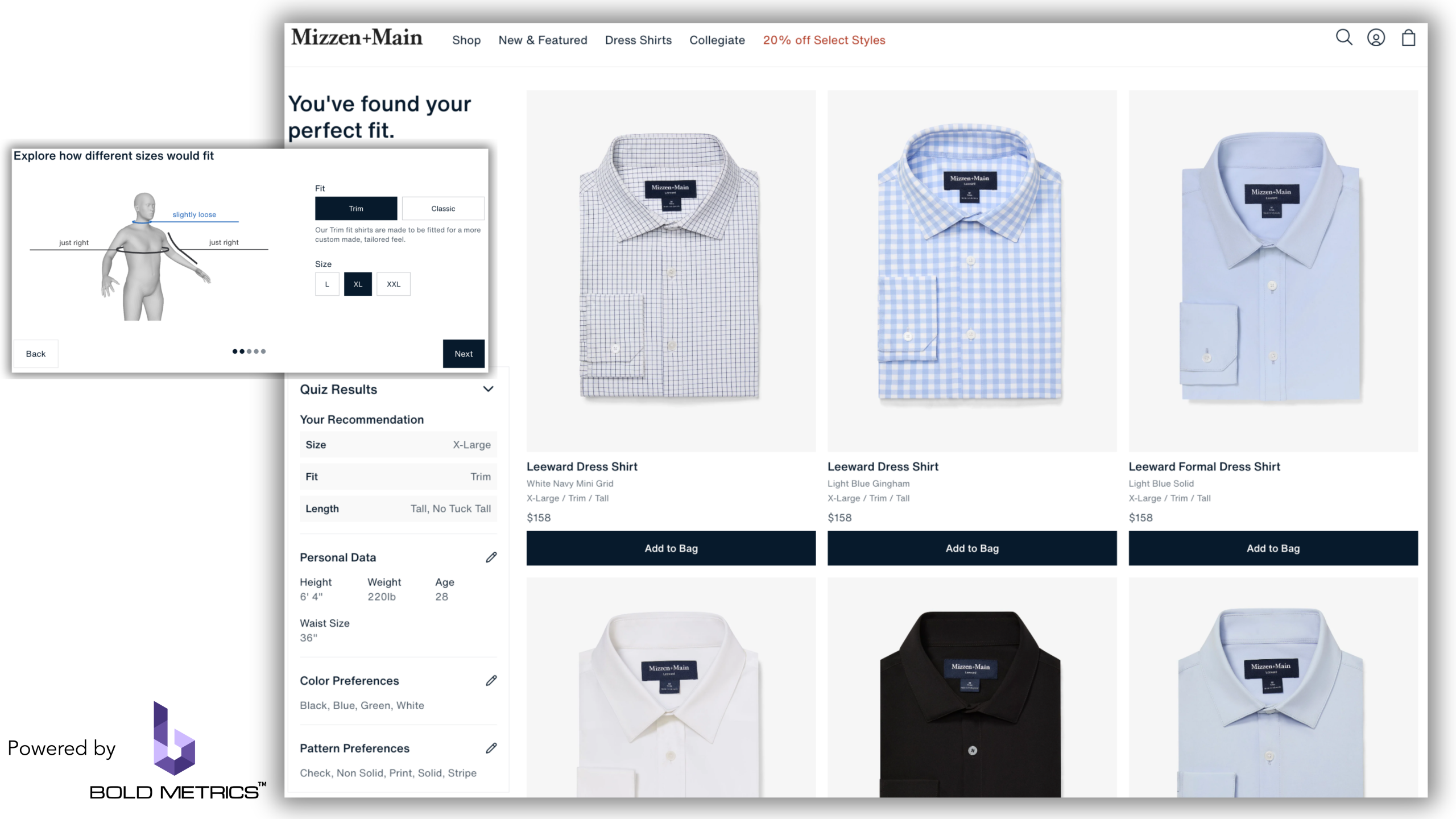
While ecommerce has made shopping more convenient in some ways, it’s added a level of complexity that frustrates consumers and drives up reverse logistics costs. Direct-to-consumer apparel brand Mizzen+Main partnered with AI-driven body data platform Bold Metrics for a smart solution to solve these problems. The company’s AI-driven tools address inconsistent apparel sizes, unreliable sizing charts and decision fatigue to help shoppers find what they’re looking for and love their purchases.
Bold Metric’s artificial intelligence creates a detailed “digital twin” of each shopper using four to six simple inputs, which are then translated virtually instantaneously into more than 50 body measurements. Behind the scenes, the shopper’s digital twin is mapped to a brand’s garment sizing specifications for a Smart Size Chart, allowing the platform to evaluate how a specific garment will fit each unique body at key measurement points, such as chest, waist, hip and sleeve.
The smart platform differs from traditional size charts, which are static grids based on assumptions that a particular size represents consistent proportions across body types. They also assume shoppers even know their measurements.
“Our system evaluates the relationship between real body dimensions and actual garment construction data,” said Daina Burnes, founder and CEO of Bold Metrics, noting that the platform goes further by incorporating an individual’s fit preference. “Two customers with identical measurements may prefer very different silhouettes depending on occasion or styling intent. By combining body measurements with fit context, we provide guidance that reflects both physical dimensions and how someone wants the garment to look and feel.”
This combination drives higher purchase confidence and measurable reductions in return rates.
Burns notes that Mizzen+Main customers who engage with fit guidance demonstrate strong purchasing behavior. Smart Size Chart users convert at an average rate of 20%, with the average order value approximately 19% higher among SSC users than among non-users.
Customers who share the same label size often have different proportions, highlighting limitations in traditional grading assumptions and opening conversations about size-curve optimization and fit-block strategy. Additionally, when shoppers can evaluate sizing based on their fit preferences, hesitation decreases.
“Aggregated body data can also reveal underserved body segments within a brand’s customer base,” said Burnes. “These insights inform broader product development decisions, including where fit coverage can expand and how silhouettes may evolve.”
Decision Fatigue
Before implementing Bold Metrics’ Shirt Finder, Mizzen+Main found that consumers lacked purchase confidence at the final point of selection—a main pain point driven by online shopping’s overwhelming number of offerings.
“Decision fatigue was a real hurdle for our shoppers. When a customer has to navigate too many options regarding fit, print and pattern without personalized guidance, that hesitation often leads to cart abandonment,” said Natalie Shaddick, SVP of marketing at Mizzen+Main, adding that the brand’s core demographic of men “typically prefer a highly streamlined shopping experience; they generally aren’t looking to browse for long periods of time.”
By first guiding consumers toward a short quiz, the Shirt Finder has made shopper behavior “noticeably more decisive” as answers let Mizzen+Main narrow offerings based on the consumer’s specific needs, thus removing the friction from the decision-making process. The Shirt Finder experience yielded a 32% engagement rate and contributed to a 7% increase in total revenue within months of launch.
“The impact of making this process quicker and easier has been massive. We’ve seen the conversion rate for customers who take the quiz more than double,” Shaddick said.
Currently, Mizzen+Main only offers the tailored experience for its dress shirts, which comprise a substantial part of the business, but they’re hoping to roll out the experience to more categories this year. “It was critical for us to prioritize that category to truly understand the data and perfect the customer journey first,” said Shaddick. “However, as we continue to build out our assortment of bottoms and expand into new fits and fabrics, applying this same technology to pants is next on our list, hopefully launching in May.”
As with any new technology, seamless integration is critical. According to Bold Metrics, the Smart Size Chart can be efficiently deployed within an existing e-commerce environment and scaled across a full catalog. The Virtual Sizer API supports more customized flows for “a more immersive experience.”
To create a foundation that is “scalable and configurable,” Bold Metrics employs data ingestion and validation, fit simulation testing across millions of body-scenario combinations and ongoing post-launch analytics reviews, according to Burnes. “Optimizations are collaborative. Each brand’s garment architecture and fit philosophy is unique, and we configure the system accordingly.”


